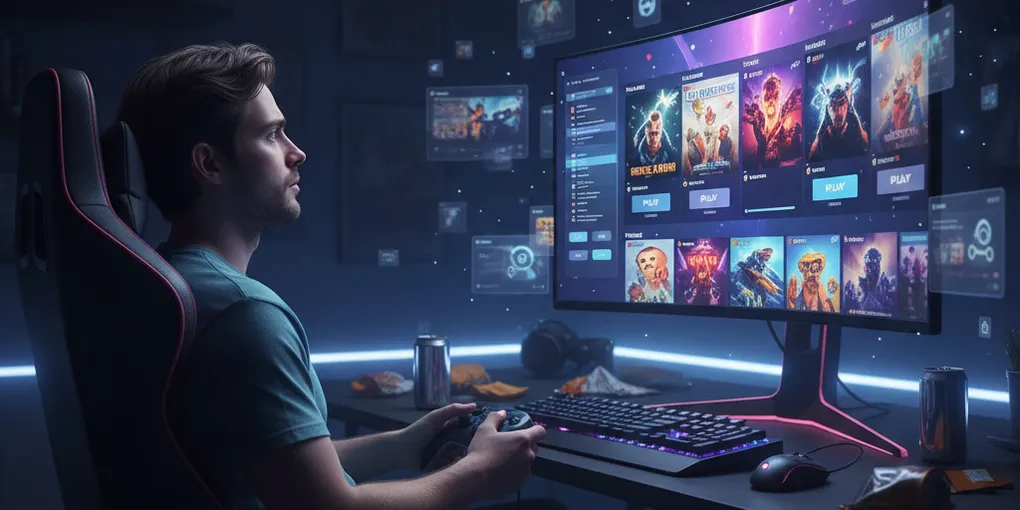
The gamer’s paradox: when your endless library leaves you staring at menus instead of playing
Here’s the thing about modern gaming it’s not that we don’t have enough games. God, we have too many.
You know what I’m talking about if you’ve ever spent a Friday night scrolling through Steam for forty-five minutes, only to give up and watch YouTube instead. Walk into any gaming subreddit (seriously, try r/gaming or r/patientgamers) and you’ll see the same confession over and over: “I’ve got like 300 games and I can’t pick what to play.”
This sounds ridiculous, right? But it’s real. It’s a actual psychological thing that’s messing with millions of us.
Back in the day I’m talking early 2000s here choosing a game was simple as hell. You saved up your allowance or whatever, bought one title, brought it home, and that was it. That was your game. The question wasn’t “what should I play?” it was more like “can I beat this level before dinner?” You know?
Fast forward to now. Steam libraries are drowning in hundreds of titles you bought during sales you don’t even remember. Game Pass throws unlimited options at you. Epic literally gives away free games every single week (I’ve claimed probably 200 games I’ll never touch). PlayStation Plus and Xbox Gold just keep piling on more stuff.
But here’s the weird part maybe because of all this abundance, not despite it we end up spending more time scrolling through menus than actually playing anything. The irony is painful.
The psychology behind gaming paralysis (or why your brain hates your library)
Choice overload is literally sabotaging your gaming sessions
So there’s this psychologist, Barry Schwartz, who figured out something he called the “paradox of choice.” Basically: when you have too many options past a certain point, you actually become less satisfied, not more.
Gaming libraries? Yeah, we’ve crossed that point. We’re way past it.
Picture this you open Steam, you see 200 unplayed games sitting there with their little progress bars at 0%. Your brain doesn’t think “wow, so many possibilities!” Instead it’s more like… responsibility? Guilt? Each game becomes:
- A massive time commitment you’re not sure you can make (is this really worth 40 hours of my life?)
- Money you spent that’s just sitting there doing nothing (I paid $30 for this during the sale, I should play it)
- A potential mistake waiting to happen (but what if there’s something better just one more scroll down?)
This whole mental calculation happens without you even realizing it. It creates this friction before you’ve even clicked “Play.”
There was this research from Columbia University they did this experiment with jam. People saw either 24 varieties or just 6. The group with fewer options? They actually bought more. Same exact principle with game libraries, except we’ve already bought everything and now we’re paralyzed by our own purchases.
Decision fatigue hits hardest after work (when most of us actually game)
Think about when you game. For most of us, it’s evenings after work, right? Which is literally the worst possible time for making decisions.
By 8 PM on a Wednesday, you’ve already made hundreds maybe thousands of decisions:
- Work stuff (projects, deadlines, that annoying email chain)
- Communication and emails (should I respond now or later?)
- What to eat for lunch, then dinner
- Social obligations you’re trying to juggle
Every single decision chips away at your mental energy. This psychologist Roy Baumeister researched something called ego depletion—basically your willpower and decision-making ability run on the same battery, and by evening that battery is dead.
So when you finally sit down to game… your decision-making capacity is already toast. Choosing between 150 titles feels impossible because your brain is running on fumes and just wants to shut down.
This is why so many of us end up doom-scrolling Twitter or TikTok instead. It requires exactly zero decisions. Just… scroll. Let the algorithm decide.
The fear of wasting your limited free time (because adult life sucks that way)
Scarcity makes everything worse.
Remember when you were a kid? Gaming time felt infinite. Summer vacation stretched forever. You could start a game, hate it after an hour, drop it, and start something else. No big deal. There was always tomorrow.
Adult gaming is different. Completely different. When you’ve only got 5-10 hours per week (if you’re lucky), every gaming session feels precious—like you can’t afford to waste it. This creates this weird performance anxiety around just… picking a game:
“If I choose wrong, I’ve wasted my only free evening this week. Then I have to wait until next Saturday to try again.”
The irony? This pressure leads to playing nothing at all. You keep searching for the perfect choice, it never materializes, and gaming never actually begins. You’ve wasted the evening anyway, just in a different way.
Why your backlog is actively killing your enjoyment
The backlog transformed from “cool collection” to “endless obligation”
Digital storefronts basically gamified the act of owning games. Sales, bundles, Humble Choice, that “fear of missing out” pricing during Steam sales… collecting games became its own separate hobby from actually playing them.
Here’s the problem though: our brains are stupid. They don’t distinguish between “games I own” and “games I’ve committed to completing.”
Looking at an unplayed library triggers the same guilt as looking at unfinished work projects on your desk. Gaming becomes another item on your endless to-do list (right between “organize closet” and “call dentist”).
This fundamentally contradicts what gaming is supposed to be. It’s leisure. It’s fun. It’s the opposite of obligations.
Sunk cost fallacy makes everything worse
You bought 30 games during the last Steam summer sale, didn’t you? (I’m not judging—I bought 47.) Most of them are still sitting there. Uninstalled. Unplayed. Just… waiting.
Rational thinking says: “Those purchases are sunk costs. Just play whatever interests me right now.”
But human psychology doesn’t work rationally—like, at all. The sunk cost fallacy sits in the back of your mind whispering: “You spent money on these. You’re basically throwing away cash if you don’t play them.”
This creates a vicious cycle that goes something like:
- Buy games on sale (because they’re 75% off!)
- Feel obligated to play your purchases (gotta get your money’s worth)
- Feel guilty about the growing pile of unplayed games
- Lose all motivation to game at all because it feels like work now
The enjoyment gets sucked out before you’ve even launched the game. It’s already ruined.
How competitive gaming actually reveals the solution (weirdly enough)
Pro gamers make decisions decisively under pressure we should too
Professional esports athletes are constantly making split-second decisions in matches:
- Which lane to push (with incomplete information)
- When to engage or retreat (reading the situation in real-time)
- How to allocate resources (gold, abilities, positioning)
They never have perfect information. They can’t sit there analyzing for five minutes. They commit to imperfect decisions and then adapt on the fly.
Casual gamers (that’s us) can actually learn from this approach. The principle is simple: action beats analysis. Always.
Choosing an “okay” game and actually playing it for 30 minutes delivers way more satisfaction than spending 30 minutes searching for the “perfect” game and ending up playing nothing. I’ve tested this. The okay game wins every time.
Momentum matters way more than optimization
Game selection isn’t about finding the objectively best title sitting in your library. That’s a trap. It’s about generating momentum—just getting started.
Once gameplay begins, enjoyment tends to follow naturally. Even if the game isn’t perfect (and honestly, what is?), the act of playing restores what gaming is supposed to provide: flow state, escapism, a challenge to overcome, or just simple relaxation.
Here’s the truth: the worst gaming session is the one that never happens. Period.
Practical solutions for decision paralysis (that actually work)
1. Implement a “three game rule” (seriously, just three)
Limit your active library to three titles maximum. That’s it. Just three.
- One story-driven game for those focused evening sessions when your brain is fresh
- One multiplayer game for social gaming with friends
- One casual game for low-energy moments when you’re drained
Hide or uninstall everything else. You’re not deleting them forever they’re just unavailable right now. Out of sight, out of mind.
This single change dramatically reduces decision points and completely eliminates that scroll paralysis where you just keep going down the list forever.
2. Match games to your current energy level (this changed everything for me)
Not all games require the same mental investment. Like… not even close.
Create an energy-based selection system for yourself:
High Energy (fresh, focused, it’s Saturday morning):
- Complex strategy games (Civilization, Crusader Kings, XCOM)
- Narrative-heavy RPGs (Baldur’s Gate 3, Disco Elysium)
- Competitive multiplayer (ranked anything, honestly)
Medium Energy (relaxed but still engaged, normal evening):
- Action-adventure games (Zelda, God of War)
- Puzzle games (Portal, The Witness)
- Cooperative multiplayer (it’s chill, less pressure)
Low Energy (completely drained, it’s 11 PM on a work night):
- Casual simulation games (Stardew Valley, Animal Crossing)
- Familiar comfort games (stuff you’ve beaten before)
- Repetitive grinding activities (farming in Warframe, whatever)
When your energy is low, trying to force yourself into Elden Ring or something creates massive resistance. Your brain just refuses. Matching game type to energy level eliminates that friction entirely.
3. Embrace comfort gaming without guilt (your 10th playthrough is valid)
Replaying familiar games isn’t failure. It’s not being lazy. It’s strategic self-care, actually.
Comfort games provide things new games can’t:
- Predictable enjoyment (you already know you’ll like it—there’s no risk)
- Reduced cognitive load (no confusing tutorials to sit through)
- Immediate flow state (you already know the mechanics, you can just… play)
So many players feel guilty about replaying games when dozens sit unplayed in their library. I’ve felt this guilt. It’s completely counterproductive though.
Your library serves you—not the other way around. Remember that.
4. Stop pre-committing to game completion (this isn’t school)
The assumption that starting a game means committing to finish it creates enormous psychological weight. Like, crushing weight.
Give yourself explicit permission to:
- Play 2 hours of a 40-hour game and just… stop
- Skip games that don’t click immediately (even if they’re “masterpieces”)
- Abandon games without guilt (yes, even if you paid full price)
Gaming isn’t school. There are no required readings. There’s no final exam. The only metric that actually matters is: “Am I enjoying this right now?”
If the answer is no, stop playing. It’s that simple (even though it doesn’t feel simple).
5. Use the “five minute rule” (this trick works surprisingly well)
When you’re completely paralyzed by choice, commit to playing literally anything for just five minutes. Set a timer if you need to.
This eliminates the pressure of making the “right” choice. You’re not committing to a 3-hour session—just five minutes. Anyone can do five minutes.
What usually happens? Those five minutes turn into an hour because momentum overcomes inertia. Your brain gets into it. But even if they don’t—even if you stop after five minutes—you’ve still gamed more than you would have spent scrolling through menus for 30 minutes.
It’s a psychological trick, but it works.
The cultural shift that created this whole mess
When productivity culture invaded our leisure time (and ruined everything)
Modern society optimizes everything now. Workouts need to be “efficient” with maximum calorie burn per minute. Sleep gets tracked with apps and scored. Even hobbies things we do for fun need to be “productive” somehow.
This toxic mindset infiltrated gaming too:
- Completion percentages became scorecards we compete with
- Achievements became mandatory goals instead of fun extras
- Game time became something to optimize for “value”
Gaming transformed from pure leisure into another performance metric. Another thing to optimize and track and feel guilty about.
The core question shifted from “Am I having fun?” to “Am I using my time optimally?” And that shift killed the whole point.
This is fundamentally broken thinking. Gaming’s value isn’t measured in efficiency or completion rates—it’s measured purely in enjoyment. That’s it.
Digital abundance created artificial scarcity (the ultimate irony)
Here’s the paradox of modern gaming that keeps me up at night: unlimited access actually created a scarcity of satisfaction.
When games were expensive and limited (one game every few months if you were lucky), finishing one felt like a real achievement. Something to be proud of. When games are cheap and unlimited, finishing one feels almost… insignificant? Because there are always 50 more waiting in your library. 100 more on your wishlist.
This creates what psychologists call a hedonic treadmill. No amount of gaming feels sufficient because your library always promises something better just around the corner. You’re never satisfied. You’re always chasing.
Redefining your relationship with gaming (before it’s too late)
Gaming is not a productivity task (let me repeat that)
The most important mindset shift you can make: you owe your game library absolutely nothing.
Those unplayed games aren’t judging you. They’re not losing value sitting there unplayed (digital games don’t depreciate). They’re simply options available if you want them. Options. Not obligations.
Viewing gaming as an obligation kills its entire purpose. It transforms play into work.
Your free time needs no justification (none. zero.)
If you choose to play nothing and watch Netflix instead? That’s completely valid.
If you replay the same comfort game for the 10th time this year? Also valid.
If you play for 20 minutes and quit because you’re not feeling it? Valid.
The only invalid choice is forcing yourself into gaming that feels like work. That’s the only wrong answer.
The bottom line: progress over perfection (always)
Gaming should restore your energy, not deplete it. If it’s draining you before you even start, something’s wrong.
If decision paralysis prevents you from gaming at all, the solution isn’t better library organization. It’s not new sorting systems or tags or categories.
The solution is giving yourself permission to:
- Choose imperfectly (pick anything, seriously)
- Play briefly (20 minutes counts)
- Quit freely (whenever you want)
- Repeat favorites (as many times as you want)
- Ignore obligations (your backlog isn’t real)
Your relationship with gaming reflects your relationship with leisure in general. If gaming has become another optimization problem to solve, you’re not gaming anymore—you’re managing. You’re working.
The healthiest gaming habit isn’t playing everything in your library. It’s playing anything whenever you genuinely want to.
Your library is a buffet, not a checklist. Take what appeals to you in the moment and leave the rest without guilt.
That’s not wasting your collection—that’s using it correctly.