The science behind gaming performance: what really Matters in your setup
Every millisecond counts in competitive gaming we all know this, right? Yet here’s the thing most players don’t want to hear: they’re dropping hundreds (sometimes thousands) of dollars on equipment because some marketing team did their job really, really well. That mouse you just bought? The one with RGB that could guide aircraft and polling rates that sound like they belong in aerospace engineering? Yeah… it might actually be worse than a properly tuned mid-tier option that costs half as much.
The peripheral market has become this weird saturated mess of products with specifications that look incredible on paper but translate to real-world advantages about as well as a chocolate teapot translates to actual functionality. Frame rates keep climbing, competitive scenes get more demanding, and somehow the gap between what companies claim their gear does and what it actually does just keeps widening. Like a canyon. A very expensive canyon.
Understanding what genuinely matters not what the spec sheet screams at you separates players seeing real improvement from those basically lighting money on fire while wondering why their rank isn’t moving.
This isn’t about buying expensive stuff. It’s about knowing which specs impact your gameplay and which are just price inflation disguised as innovation.
If you’re building a complete gaming setup, start with our main guide: Ultimate Gaming Setup Guide
The science behind gaming performance measurement
Before we dive into specific gear (and trust me, we’re going there), we need to talk about how performance should actually get evaluated. The industry has leaned on subjective impressions and theoretical specs for way too long, but serious analysis? That demands objective methodology. Cold, hard data.
Controlled testing environments eliminate the variables that contaminate results consistent OS builds, identical driver versions, firmware standardization across every piece of tested equipment. Without this foundation, you’re just… comparing apples to aircraft carriers, basically. Meaningless exercises dressed up as science.
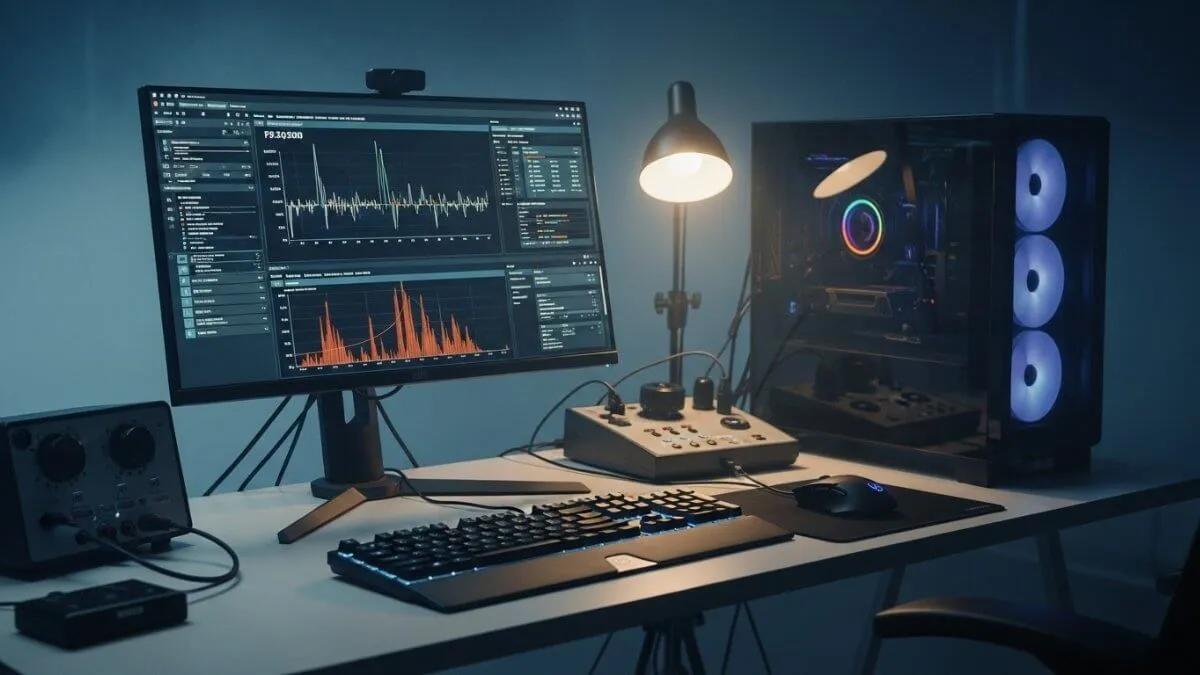
Repeatability forms the cornerstone here. Single test runs? They tell incomplete stories at best, outright lies at worst. Multiple benchmark iterations reveal consistency patterns or concerning variance that single samples hide like secrets. A mouse performing brilliantly during one ten-minute session but showing latency spikes during marathon play sessions? That’s not high-performance equipment. That’s a ticking time bomb wrapped in marketing speak.
The metrics extending beyond basic specifications actually matter: input latency in milliseconds, polling stability and variance, sensor accuracy deviation, signal-to-noise ratios for audio gear, refresh rate consistency, frame pacing. Build quality under sustained stress reveals whether equipment maintains its performance characteristics over time or degrades faster than your faith in humanity after browsing social media.
Gaming mice: when more isn’t always better
The gaming mouse represents your most direct interface between human intention and digital execution. Get this wrong—no amount of skill compensates for hardware limitations. Period.
Yet this pursuit of ever-higher polling rates has created a specification arms race that obscures what actually matters. It’s like watching car manufacturers compete over who can make the loudest exhaust note while ignoring whether the engine works properly.
Sensor fidelity genuine one-to-one tracking without smoothing or prediction algorithms mucking things up—determines whether your hand movements translate accurately to cursor motion. Many high-end mice (and I’ve tested enough to make my wrist hurt just thinking about it) sacrifice this fundamental quality for aggressive marketing specifications. The result? Tracking that feels “off” in ways you can’t quite articulate but definitely experience. Like trying to describe the color blue to someone who’s never seen it.
Polling rate stability matters infinitely more than peak polling rates. An 8000 Hz mouse exhibiting variance and occasional polling drops? Worse real-world performance than a rock-solid 1000 Hz implementation. Every. Single. Time. The human nervous system can’t detect differences beyond certain thresholds anyway, making ultra-high polling rates a solution desperately searching for a problem at least until monitor tech and system latency paths catch up (which, let’s be honest, might take a while).
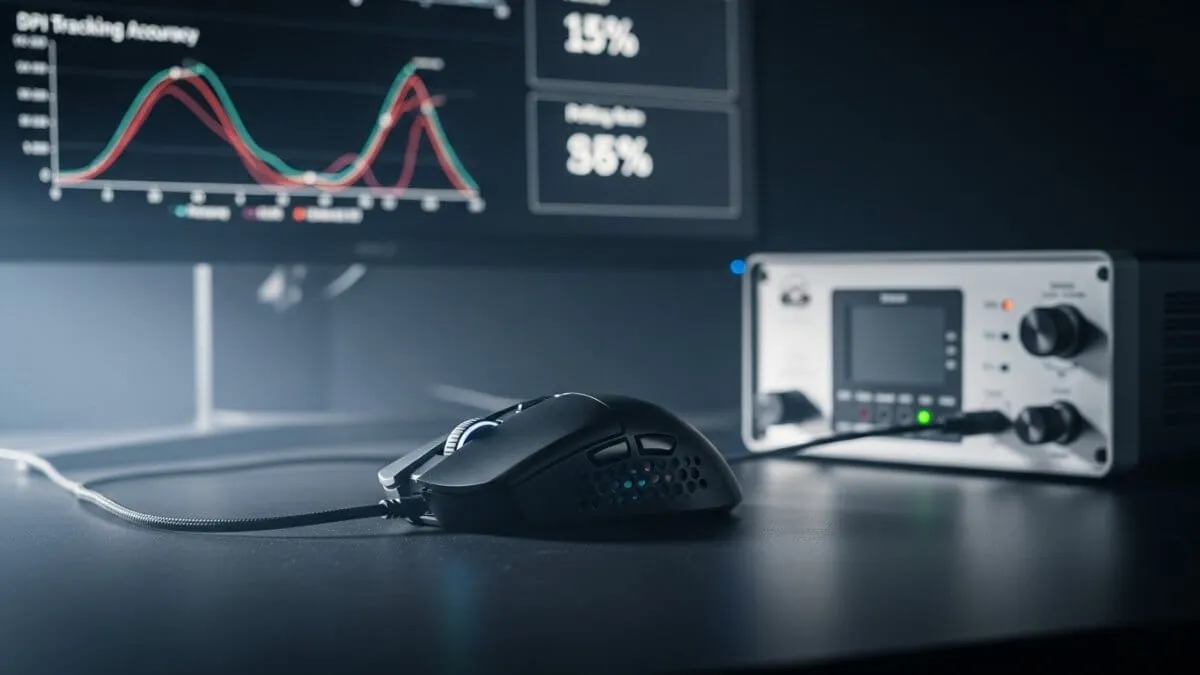
Professional testing setup analyzing gaming mouse sensor accuracy, DPI tracking, and real-world performance consistency.
Click latency and debounce reliability directly impact reaction-dependent scenarios. In competitive shooters where first-shot accuracy determines who walks away and who respawns, even 2-3 milliseconds of additional latency compounds across hundreds of engagements. It’s death by a thousand cuts, except each cut is measured in microseconds.
Weight balance and grip ergonomics might seem secondary they’re not. They directly influence fatigue resistance during extended sessions, which influences consistency, which influences whether you’re fragging or getting fragged.
Professional players consistently choose mice with flawless sensor implementation and stable polling over exotic specs. There’s a lesson buried in that pattern. Listen to it.
To understand how your full setup impacts performance, check : our complete gaming setup guide
Mechanical keyboards: beyond the satisfying click
Keyboard marketing has evolved into this minefield of switch types, actuation points, and feature claims that correlate with competitive advantage about as well as your horoscope correlates with stock market performance.
Stripping away the noise reveals what actually influences performance and it’s not always what you think.
Actuation force consistency across the entire keyboard ensures predictable input behavior. Inconsistent switches create muscle memory problems where your fingers never quite know how much pressure triggers activation. It’s subtle. It’s insidious. It’s absolutely real.
Modern magnetic switch designs and rapid-trigger implementations show genuine advantages in specific scenarios particularly counter-strafing in tactical shooters where directional changes demand immediate deactivation and reactivation. I’ve seen this work. I’ve also seen people buy these keyboards for games where it provides zero advantage because, again, marketing.
Debounce behavior represents the hidden performance killer nobody talks about at LAN parties. Poor debounce algorithms introduce latency or (somehow worse) phantom inputs registering unintended keypresses. Firmware quality determines whether exotic hardware features actually function reliably or become competitive liabilities that make you rage-quit hardware instead of games.
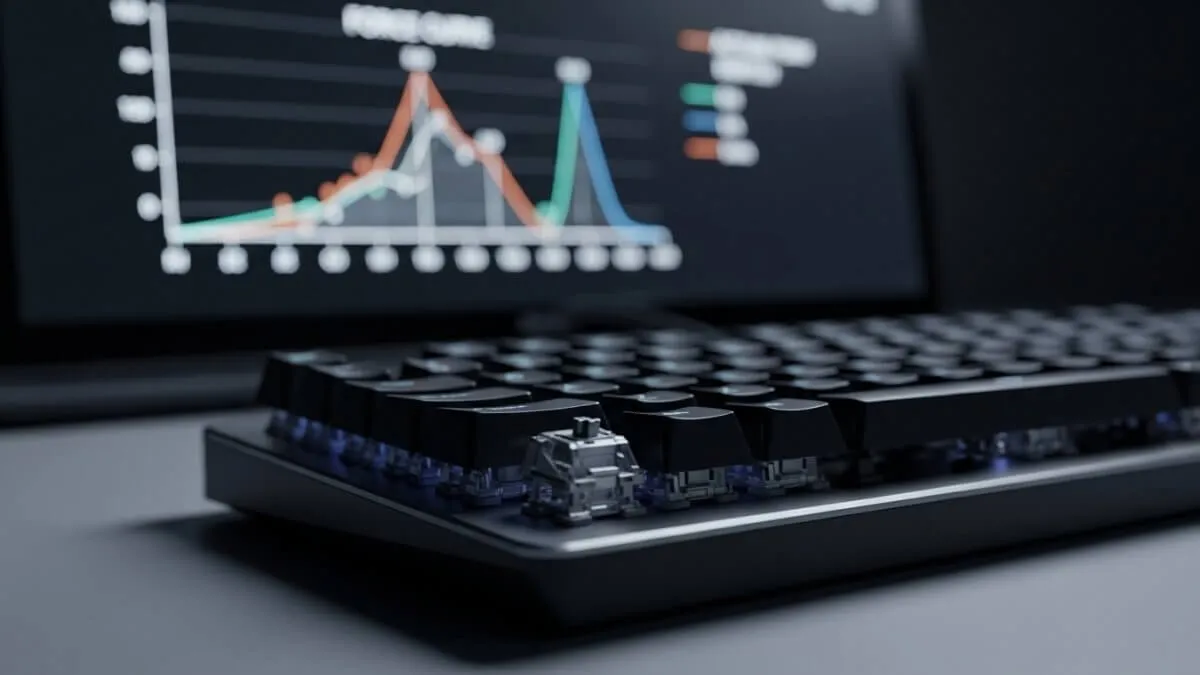
Close-up analysis of mechanical keyboard switch actuation and response behavior in competitive gaming conditions.
Input latency from keypress to signal transmission varies significantly across keyboards marketed at similar price points. The difference between 5ms and 15ms might seem trivial on paper it compounds across thousands of inputs per session. Math is unforgiving like that.
Stabilizer quality affects larger keys, particularly the spacebar which gets absolutely hammered in virtually every game genre. A wobbly spacebar isn’t just annoying it’s a performance handicap.
The keyboard market’s obsession with luxury materials and premium construction often distracts from performance fundamentals. A well-engineered mid-tier keyboard frequently (and I mean frequently) outperforms poorly optimized premium alternatives that look gorgeous in Instagram photos but feel terrible during clutch moments.
Gaming headsets: hearing what actually matters
Audio equipment faces perhaps the most egregious gap between marketing and performance. Like, it’s not even close.
“Gaming” headsets often feature heavily sculpted frequency responses that sound impressive during casual listening but actively harm competitive performance. It’s like wearing sunglasses at night technically you’re wearing eyewear, but you’re doing yourself no favors.
Frequency response neutrality enables accurate positional audio. Exaggerated bass and treble might make explosions feel more visceral (and they do, it’s genuinely satisfying), but they obscure subtle audio cues footsteps, reloads, ability usage that provide competitive intelligence. Professional players almost universally prefer flatter frequency curves prioritizing accuracy over excitement. They’re not trying to feel cool explosions. They’re trying to win.
Imaging and positional accuracy separate competent headsets from competitive tools. The ability to precisely locate sound sources in three-dimensional space provides enormous tactical advantages, particularly in games where audio information reveals enemy positions before visual confirmation. It’s wallhacks, but legal.
The “7.1 surround sound” feature ubiquitous in gaming headsets? Marginal benefit compared to accurate stereo imaging with proper EQ calibration. Virtual surround processing often introduces artifacts that reduce clarity literally the opposite of the intended effect. It’s solving a problem that doesn’t exist while creating problems that definitely do.
Microphone quality varies wildly. Compression artifacts are the most common bottleneck in communication clarity, which matters when you’re trying to coordinate complex plays and your teammates can’t understand whether you said “flash left” or “dash right.”
Dynamic range and distortion characteristics determine whether audio remains clear during chaotic combat scenarios with overlapping sound sources. Cheap drivers struggle when multiple sounds compete for attention, creating muddy audio that masks important information like someone trying to have a conversation at a metal concert.
Gaming monitors: the refresh rate deception
Monitor marketing has convinced consumers that refresh rate alone determines performance. This oversimplification ignores critical factors that dramatically impact real-world experience and I mean dramatically.
Pixel response time consistency across brightness levels separates excellent panels from mediocre ones wearing impressive specifications like borrowed suits. A 360 Hz monitor with inconsistent response times delivers worse motion clarity than a well-tuned 240 Hz alternative. It’s not even a competition.
Excessive overdrive settings introduce inverse ghosting trailing artifacts that reduce visual clarity during fast motion. You’re literally making the image worse to make numbers look better on marketing materials.
Input lag comprises both signal processing and pixel transition time. Marketing materials trumpet refresh rates while conveniently omitting processing delays that negate theoretical advantages. It’s the fine print nobody reads until they’re wondering why their expensive monitor feels sluggish.
Adaptive sync behavior during frame rate fluctuations reveals whether variable refresh rate implementations actually deliver smooth experiences or introduce stuttering and tearing at critical moments like, you know, when you’re trying to track enemies during firefights.
Panel uniformity affects color accuracy and brightness consistency across the display surface. Competitive players need reliable visuals in all screen regions, not just the sweet spot in the center where demo content focuses attention.
The monitor market’s specification inflation has created unrealistic expectations. A properly calibrated display with moderate specs consistently (there’s that word again) outperforms poorly tuned panels with impressive spec sheets.
For a deeper breakdown of what actually improves gaming performance, see : this comprehensive setup guide
Controllers: the console crossover challenge
As cross-platform gaming expands and it’s expanding fast controller quality matters even in traditionally mouse-and-keyboard genres. Wild times we’re living in.
Precision testing reveals significant performance variance across superficially similar products. Not all controllers are created equal, despite looking nearly identical.
Stick resolution and drift resistance determine longevity and accuracy. Hall-effect implementations demonstrate superior durability and reduced drift risk compared to traditional potentiometer designs. This is one area where newer technology actually delivers on its promises.
Trigger response curves affect racing games and shooters differently, making customization depth increasingly valuable. What works for Forza doesn’t work for Apex, and having options matters.
Wireless latency stability has improved dramatically but still varies across manufacturers. Inconsistent wireless performance creates input lag that fluctuates unpredictably arguably worse than consistent higher latency. At least with consistent lag you can adapt. Unpredictable lag? That’s just chaos.
The durability factor nobody discusses
Peak performance means absolutely nothing if your equipment fails after three months. Long-term reliability testing reveals uncomfortable truths about build quality that launch reviews rarely capture because… well, launch reviews happen at launch, not six months later.
Button endurance, cable stress resistance, thermal stability, firmware reliability over extended time periods all contribute to true value calculations. Products maintaining consistent performance after months of heavy use deserve premium consideration even when initial specs appear modest compared to flashier alternatives.
The most expensive gear isn’t always the most durable. Some mid-tier products with conservative specifications dramatically outlast premium alternatives prioritizing aesthetics over engineering fundamentals. It’s the tortoise and hare fable, except the hare costs three times as much and breaks faster.
Strategic upgrade philosophy for serious players
Serious gaming performance stems from system coherence, not isolated upgrades. This is crucial upgrading one component without considering the entire system often delivers disappointing results.
Precision-tested gear consistently demonstrates that consistency outperforms peak specs, firmware quality rivals hardware design in importance, and ergonomics directly influence reaction time and endurance. These aren’t theories. They’re observable, repeatable patterns.
Marketing features rarely correlate with measurable advantage. The gaming industry’s specification arms race benefits manufacturers more than players shocking, I know. Understanding which specifications actually impact your specific use case (competitive FPS, MOBA, racing, streaming they’re all different) enables informed purchasing decisions delivering genuine performance improvements rather than placebo effects.
For competitive players and performance-focused enthusiasts, validated, benchmark-proven gear yields tangible results in both gameplay outcomes and long-term reliability. This isn’t about excess it’s about control, predictability, execution when milliseconds matter.
The question isn’t whether expensive gear performs better than budget alternatives. Often it does. The real question? Whether that performance difference justifies the cost and whether you’ll actually perceive the improvement in your specific gaming context.
Only objective testing reveals those answers. Everything else is just noise.
If you’re serious about optimizing your full setup, start here: Ultimate Gaming Setup Guide